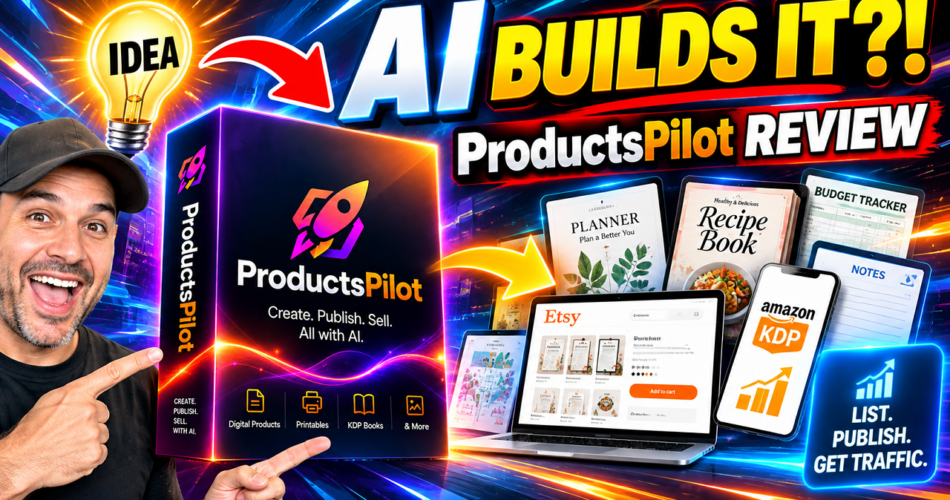
ProductsPilot Review: Can Four AI Agents Really Build and Sell Digital Products for You?
Introduction – What Is ProductsPilot?
Creating a digital product sounds simple until I actually break down everything involved. First, I need to figure out what people want to buy. Then I have to create the product, make it look professional, write the listing, produce mockups, decide on pricing, publish it, and somehow bring potential buyers to the offer.
That is exactly the problem ProductsPilot is designed to address.
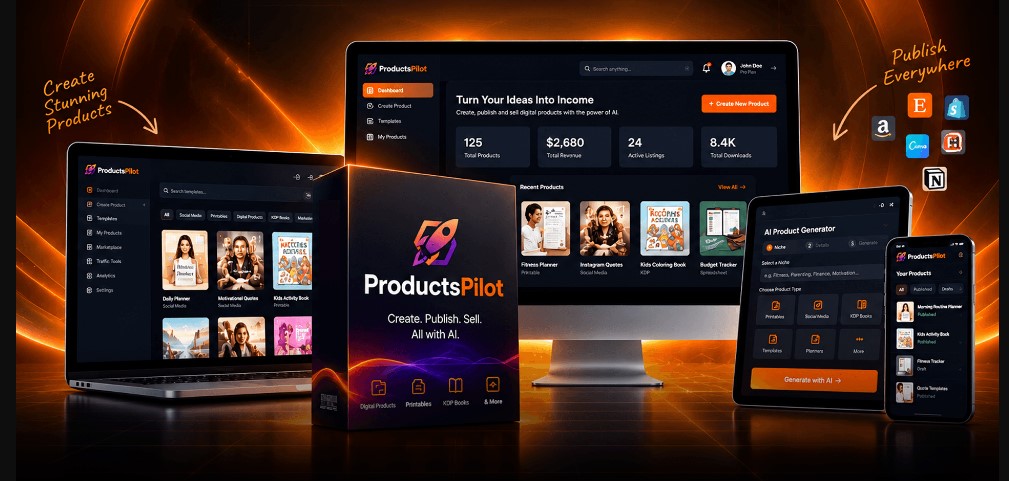
ProductsPilot is an AI-powered platform built around four specialized AI agents. Instead of giving me another isolated AI generator, the idea is to automate several stages of the digital-product business inside one workflow.
Agent one researches products and niches to help determine what people are buying. Agent two creates the actual digital product as a complete, matching, print-ready set. Agent three handles the commercial side by creating mockups, writing the listing, suggesting a price range, and preparing or publishing the product to a marketplace. Agent four tackles another major challenge: traffic.
According to the current ProductsPilot materials, the Traffic Agent is designed to promote listings across seven channels.
What really catches my attention is the simplicity of the workflow. The core idea is that I choose a niche and choose a visual direction. ProductsPilot handles much of what comes after those decisions.
For beginners who have always wanted to sell digital downloads but have been stopped by design, research, copywriting, or marketing, that is an interesting proposition.
However, ProductsPilot is still in its pre-launch period at the time of this review. Its public launch is scheduled for September 29, 2026. That means some of its biggest claims still need to be judged against real-world customer use after release.
👤Vendor: Abhi Dwivedi
🎁Product: ProductsPilot
🗓️Launch Date: 2026-Sep-29
🏷️Front-End Price: $37
⭐Recommend: Highly recommend
🏆Skill: All Levels
🏅Guarantee: 30-Day Money Back Guarantee
🛎️Support: Еffесtіvе Rеѕроnѕе
🔥 Visit the Official Website
ProductsPilot Design and Overall Quality
From a workflow perspective, one thing I like about ProductsPilot is that it appears to have been designed around a business process instead of around individual AI features.
That distinction matters.
Plenty of AI applications can generate text. Others can create images. Design applications can make templates and mockups. Keyword tools can research opportunities. Social tools can help distribute promotional material.
The problem is that I usually have to connect those pieces myself.
ProductsPilot attempts to turn those separate jobs into one connected system.
The software is browser-based according to the vendor’s current information, which should make it accessible without requiring complicated desktop installation. The free research app is also advertised as working on laptops and phones.
The real quality test, though, will be the output.
AI automation is useful only when the resulting products are good enough to sell. I would therefore pay close attention to typography, formatting, visual consistency, file resolution, listing accuracy, mockup quality, and whether the final product actually provides meaningful value to customers.
A fast workflow is great. A high-quality finished product is more important.
ProductsPilot Key Features and Functionality
Agent 1 – Find Digital Products People Want
The first ProductsPilot AI agent tackles what I consider one of the most important parts of selling digital products: deciding what to sell.
It is easy to make something I personally like. That does not necessarily mean anybody wants to buy it.
The research component is designed to identify digital-product opportunities while looking at factors such as demand, competition, and existing prices.
This could save beginners a lot of guesswork.
Instead of starting with a blank page and wondering whether to make wedding printables, planners, educational materials, budgeting products, pet-related downloads, or something completely different, I can begin with market information.
I particularly like this approach because it puts research before creation.
If I am going to spend time producing something, I would rather begin with evidence of existing buyer interest than simply hope demand appears afterward.
Agent 2 – Build the Complete Digital Product
Agent two is where ProductsPilot becomes particularly interesting.
The vendor emphasizes that this agent is intended to create a complete, matching, print-ready product set, rather than simply generating one AI image.
That difference is important.
An attractive image is not automatically a digital product. A customer buying a printable set, planner, template bundle, or similar download expects something polished and usable.
ProductsPilot is designed to take the niche and selected visual direction and build the product around them.
For me, the potential benefit is speed.
I would not necessarily have to become an expert designer before experimenting with digital products. I can choose the direction I want and let the system handle a substantial amount of the production process.
That could make digital-product creation considerably more accessible to beginners.
Agent 3 – Create the Listing, Mockups and Pricing
Making a product is only half the job.
I still need to sell it.
Agent three is designed to create the product mockups, write the listing copy, determine a suitable price band, and help get the product published to a marketplace.
I think this is one of ProductsPilot’s more practical features because listing creation is surprisingly time-consuming.
A strong marketplace listing needs a clear title, persuasive description, relevant product information, attractive visuals, and appropriate pricing.
ProductsPilot attempts to automate much of this process.
Mockups are particularly valuable because customers cannot physically hold a downloadable product. Presentation therefore plays a huge role in communicating what buyers receive.
If ProductsPilot consistently creates attractive mockups and useful listing copy, this feature alone could eliminate a considerable amount of repetitive work.
Agent 4 – Generate Traffic Across Seven Channels
This may be the feature I am most curious to test.
ProductsPilot’s fourth AI agent is designed to promote the listing through seven traffic channels.
This tackles one of the biggest misconceptions about digital products: uploading something does not automatically produce sales.
Traffic still matters.
ProductsPilot attempts to extend the automation beyond creation and publishing into promotion.
That makes the platform different from a basic AI design generator.
However, I would keep my expectations realistic. Traffic does not automatically mean buyers, and promotional activity does not guarantee profitable sales. Product quality, niche demand, competition, pricing, marketplace algorithms, listing conversion rates, and customer preferences can all influence results.
I see the traffic agent as a way to reduce promotional workload, not as a guaranteed sales machine.
How ProductsPilot Works
The workflow appears intentionally straightforward.
Step 1 – Pick a Niche
I start by deciding which market I want to target. The research tools can help me evaluate opportunities instead of choosing blindly.
Step 2 – Pick a Look
Next, I choose the visual direction I want for the product.
Those are essentially the two major creative decisions emphasized in the current ProductsPilot presentation.
From there, the four agents are designed to research, create, package, list, and promote the digital product.
For somebody who dislikes complicated software, I can see why this approach would be attractive.
ProductsPilot vs Similar Tools
ProductsPilot is slightly difficult to compare with a single competitor because it attempts to combine several categories of software.
With a traditional design platform such as Canva, for example, I can access templates and design tools, but I still have to decide what to make, customize the design, write my marketplace listing, determine my pricing, publish the product, and handle promotion.
AI image generators can speed up asset creation, but an image is not necessarily a complete product business.
AI writing tools can help me produce descriptions and marketing copy, but they generally do not manage the entire product workflow either.
ProductsPilot’s main distinction is therefore integration.
Instead of trying to be only a designer or only a copywriter, it aims to connect research, creation, listing, publishing, and promotion.
Whether it is actually better for a particular user will depend heavily on the quality of those automated outputs once the finished platform is available.
ProductsPilot Pros and Cons
Pros
Four specialized AI agents: I like having different AI processes dedicated to research, product creation, listings, and traffic.
Beginner-friendly concept: I do not need advanced graphic-design knowledge to understand the intended workflow.
Complete product creation: ProductsPilot is being positioned around complete print-ready sets rather than isolated AI-generated pictures.
Listing automation: Having AI create descriptions, mockups, and pricing guidance could save considerable time.
Traffic component: Promotion is built into the concept rather than being left entirely to the user.
No inventory: Because the focus is digital products, I do not need physical stock or shipping logistics.
Research-first approach: I can investigate potential demand before committing to a product idea.
Cons
The biggest limitation right now is simply that ProductsPilot has not publicly launched yet. That means I cannot rely on a large body of independent customer experiences or long-term case studies.
AI-generated products will also still need human review. I would never blindly publish an AI-created product without checking its accuracy, formatting, originality, licensing implications, usability, and overall customer value.
Traffic is another area where expectations should stay sensible. Seven promotional channels sound useful, but no traffic system can guarantee sales.
Finally, marketplace rules can change. Sellers remain responsible for making sure their products and listings comply with whichever platforms they use.
Why ProductsPilot Stands Out
The biggest advantage I see is not one individual AI feature.
It is the attempt to connect the entire workflow.
A lot of tools help me create something. ProductsPilot is trying to answer the next questions too:
What should I create?
How should it look?
How should I present it?
What should the listing say?
How should I price it?
Where should I publish it?
How do I start getting people to see it?
That end-to-end philosophy is what makes ProductsPilot interesting to me.
ProductsPilot User Experiences and Testimonials
Because ProductsPilot is scheduled to launch on September 29, 2026, genuine independent post-purchase customer reviews are not yet available at the time of writing.
That distinction is important.
Pre-launch review pages discuss the concept and vendor materials, and vendor-selected beta feedback may appear in promotional material, but those are not the same as having months of independent customer reviews.
For that reason, I would not present early promotional testimonials as proof that an average customer will achieve the same results.
After launch, the feedback I would watch most closely is whether users find the generated products genuinely sale-ready, whether the marketplace publishing process works smoothly, and whether the seven-channel traffic functionality produces meaningful visitors.
Things Customers Will Want to Know
“Is ProductsPilot Really Beginner Friendly?”
The entire concept appears to be built around reducing technical and creative barriers. Choosing a niche and visual style is far simpler than manually building every stage of a digital-product business.
“Does It Create Complete Products?”
According to the vendor’s current materials, yes. The Creation Agent is intended to generate complete matching, print-ready sets rather than a single image.
“Will ProductsPilot Make Sales Automatically?”
I would not assume that. ProductsPilot can potentially automate many tasks, but sales still depend on the product, niche, marketplace, competition, pricing, traffic, and conversion.
“Do I Need Graphic Design Experience?”
The system is specifically positioned as requiring no design expertise. That is one of its main attractions.
“Do I Need Paid Advertising?”
The vendor positions ProductsPilot around promotion through seven traffic channels without requiring paid ads. I would still judge the actual traffic quality after launch.
“Can It Save Me Time?”
Potentially, yes. Combining research, creation, mockups, copywriting, publishing, and promotion could eliminate a lot of repetitive manual work.
“Should I Check Everything Before Publishing?”
Absolutely. AI should make the workflow faster, but I would still perform final quality control before selling anything to customers.
Tips and Tricks for Getting More From ProductsPilot
I would start with narrow niches instead of targeting huge general markets. Specific audiences make it easier to understand what the buyer actually wants.
I would also use the research agent before generating products rather than creating random designs first.
Once ProductsPilot generates a product, I would inspect every page or file manually. I would check spelling, formatting, consistency, resolution, usefulness, and anything that could affect the customer experience.
I would also test multiple visual directions and listings instead of assuming the first output will always be optimal.
Most importantly, I would treat ProductsPilot as an automation assistant rather than a substitute for business judgment.
ProductsPilot Specifications
Product Name: ProductsPilot
Product Type: AI digital-product creation and marketing platform
Core Technology: Four specialized AI agents
Agent 1: Product and niche research
Agent 2: Complete digital-product creation
Agent 3: Mockups, listing copy, pricing, and marketplace publishing workflow
Agent 4: Traffic and product promotion
Traffic Channels: Seven channels advertised
Design Experience Required: Designed for users without advanced design skills
Physical Inventory Required: No, for the digital-product workflow described
Paid Advertising Required: Not required by the promoted workflow
Platform: Browser-based according to current vendor information
Public Launch: September 29, 2026
Why ProductsPilot Could Work for You
ProductsPilot makes the most sense to me for somebody whose biggest obstacle is execution.
Maybe you have wanted to sell digital products but get stuck trying to choose a niche. Perhaps design software feels intimidating. Maybe writing marketplace descriptions is not your strength. Or perhaps you can create products but never promote them consistently.
ProductsPilot attempts to remove several of those bottlenecks at once.
Instead of mastering four different disciplines before publishing my first product, I can potentially use the AI agents to accelerate each stage and concentrate on selecting opportunities, reviewing the results, and improving what works.
Who Is ProductsPilot For?
I see ProductsPilot being most relevant to beginners, digital marketers, affiliate marketers, side-hustle builders, content creators, coaches, freelancers, and existing digital-product sellers who want to speed up production.
It could also appeal to people who have ideas but lack confidence with design.
More experienced sellers may find value in using it to rapidly test multiple niches and product concepts rather than manually building every experiment.
Overall Value
The value proposition is straightforward: ProductsPilot attempts to replace a collection of separate workflows with one AI-assisted system.
Instead of using one application for research, another for graphics, another for writing, another for mockups, and additional tools for promotion, I can potentially handle much more of the process from one place.
That could save both time and complexity.
The big question is execution. The platform’s value will ultimately depend on how good its finished products are, how reliably its marketplace workflow functions, and how useful its traffic system proves in everyday use.
Prices And Upsells
Front-End: ProductsPilot $37
The complete business: 8 product types on the front end, 15 products a month, 2 shops, demand-scored niche data, the creation engine, print files and mockups, written listings for Etsy and Gumroad, one-click Gumroad publishing, the full 7-channel Traffic Builder, trademark screening and full commercial rights.
First Offer: FastPass Bundle $230 per year
Shown immediately after the front end, before anything else. Every feature upgrade below in one click at a steep discount, plus FastPass-exclusive bonuses. This is the gate: accept it and the buyer unlocks access to the Gold DFY Vault next. Decline it and they go down the individual OTO sequence instead — the Vault never shows. That exclusivity is the entire sell on this offer, so it has to be enforced in the funnel logic, not just promised in the copy.
Exclusive: ProductsPilot Gold, The DFY Vault $197
Shown only to FastPass, Bundle Deal, and Lifetime Bundle buyers. The hero upsell, and now a genuine reward for the buyers who commit hardest. It removes the last decision they have to make: 500 pre-built, demand-researched products across every category and season. Every one is re-created uniquely for that user — different palette, different layouts, different listing copy — so no two customers ever end up selling identical products in the same marketplace. That uniqueness engine is what makes a DFY vault worth owning, and it converts hard to somebody who just watched their first product build itself.
OTO 1: ProductsPilot Unlimited $67 per year
The power-user tier. The premium image model, a visible step up in output quality, plus unlimited products, bulk creation 20 at a time, priority queue so their jobs run first under launch load, and API access.
OTO 2: ProductsPilot Diamond Storefront $97 per year
Right now they sell to hundreds of people and own none of them — every buyer belongs to Etsy, to Gumroad, to whichever marketplace took the cut. Diamond Storefront fixes that: a branded storefront that’s actually theirs, buyer capture on every sale, AI-written follow-up sequences that turn a one-time $20 buyer into a repeat customer, a bundle builder to package their catalogue into bigger sells, and direct checkout with zero marketplace cut. This is the step from “I sell files on other people’s platforms” to “I own a customer list and a brand.”
OTO 3: ProductsPilot Platinum Agency $97
Turns it into a business with clients: 25 shops, client records, full white-label branding, an optional custom domain for client delivery pages, and automated branded PDF reports. Everything needed to charge coaches, course creators and local businesses a monthly fee for work the AI does.
OTO 4: ProductsPilot Elite, Marketplace Multiplier $67 per year
This is the one that multiplies their income without multiplying their work. Adds the ninth product type, low-content books for Amazon KDP, plus Shopify, Printify, Teachers Pay Teachers, Creative Market, Design Bundles, Payhip and Notion, each with its own written listing. Same product, ten places to get paid, and Traffic Builder points at all of them.
Direct Link: Bundle Deal $317 per year
Front end plus every upgrade in a single transaction, promoted straight from your affiliate link — for buyers who skip the sequence and want it all at once. Carries the MegaBundle as an order bump on the order form, and qualifies the buyer for the Gold DFY Vault page immediately after checkout.
Direct Link: Lifetime Bundle $497 one time
The same everything, paid once instead of annually — for buyers who’d rather own it outright than rebill. Also carries the MegaBundle order bump, and also qualifies the buyer for the Gold DFY Vault page right after.
Order Bump: MegaBundles $77
Shown only on the Bundle Deal and Lifetime Bundle order forms. The final add-on for the highest-intent buyers.
ProductsPilot Product Summary
ProductsPilot takes an ambitious approach to digital-product automation.
Its four AI agents address four jobs that frequently stop beginners: finding an opportunity, creating a professional product, building a marketplace listing, and attracting traffic.
I especially like the fact that the system is not positioned simply as an AI image generator. Creating complete, print-ready sets makes much more sense for somebody who actually wants to build a digital-product catalog.
At the same time, I would keep realistic expectations.
Automation can dramatically reduce repetitive work, but it does not eliminate competition, marketplace rules, customer expectations, or the need for quality control.

Final Recommendation
ProductsPilot looks most interesting to me for people who want to enter the digital-product market but have been held back by the number of different skills traditionally required.
The four-agent structure is its strongest idea. Research feeds creation, creation feeds the listing, and the finished listing feeds promotion. That creates a much more complete workflow than using a standalone AI writer or image generator.
I also like the simplicity of the concept: pick a niche, pick a look, and let the AI agents handle much of the heavy lifting.
However, because ProductsPilot is still in its pre-launch stage as I write this review, I would distinguish its advertised capabilities from independently demonstrated long-term results. I would especially want to evaluate the quality of generated products, publishing reliability, and real traffic performance after launch.
For beginners, marketers, creators, and existing digital-product sellers who value automation, ProductsPilot is certainly a platform worth watching closely.
If the four agents perform as described, its biggest strength will not be AI generation by itself. It will be turning several disconnected jobs—research, creation, listing, publishing, and promotion—into one streamlined digital-product workflow.
ProductsPilot FAQ
What Is ProductsPilot?
ProductsPilot is an AI-powered digital-product platform built around four agents that handle research, product creation, listing preparation and publishing, and traffic generation.
How Many AI Agents Does ProductsPilot Have?
ProductsPilot uses four main agents, with each one focusing on a different part of the digital-product workflow.
Does ProductsPilot Create the Actual Product?
According to its current materials, yes. The Creation Agent is designed to generate a complete matching, print-ready digital-product set.
Does ProductsPilot Create Marketplace Listings?
The Listing Agent is designed to create mockups, listing copy, and pricing guidance and facilitate publishing to supported marketplaces.
Does ProductsPilot Generate Traffic?
ProductsPilot’s Traffic Agent is advertised as promoting listings across seven channels.
Do I Need an Existing Audience?
The product is marketed toward users without an existing audience because its workflow includes traffic generation. However, I would not interpret that as a guarantee of sales.
When Does ProductsPilot Launch?
ProductsPilot is currently scheduled to launch publicly on September 29, 2026.
