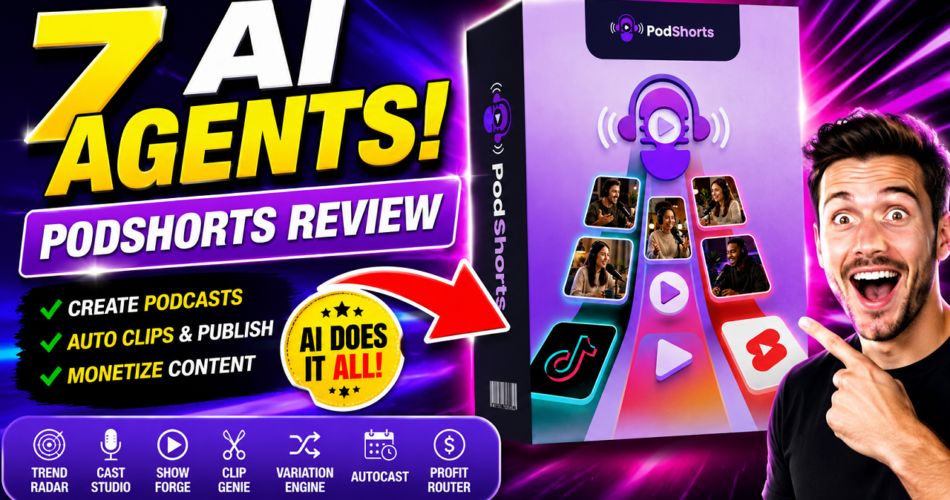
PodShorts Review: Can This 7-Agent AI Really Automate Podcast Content?
Introduction: What Is PodShorts?
Creating a podcast sounds simple until you actually start doing it. You need ideas, scripts, recording, editing, clips, captions, publishing, promotion, and some kind of monetization strategy. For me, that workload is what makes PodShorts interesting.
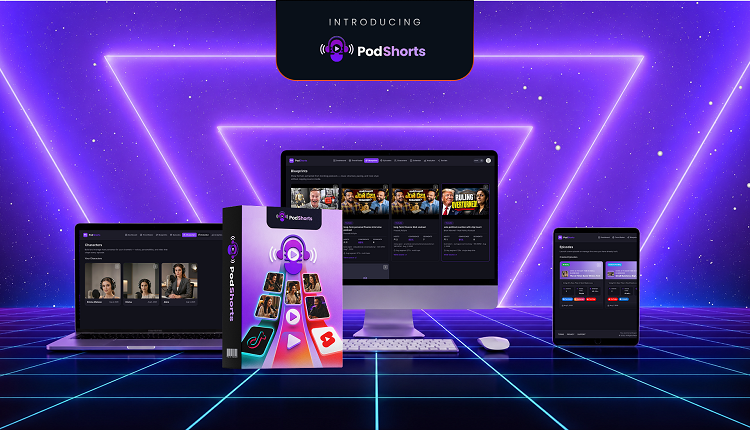
PodShorts is an AI-powered application designed to generate complete podcast-style shows from text and then transform that content into daily, platform-specific podcast clips. Instead of requiring you to handle every stage manually, the platform uses a team of seven specialized AI agents.
Each agent is assigned a particular part of the workflow. Together, these agents are intended to perform tasks that would normally require a podcast production studio, video editor, social media team, and link-management system.
That is an ambitious idea.
What caught my attention most is that PodShorts isn’t simply positioned as another AI script generator or short-video creator. The concept is much broader: enter your content or idea, allow the AI system to develop it into podcast content, and then use that content to produce short-form material suitable for ongoing distribution.
In this PodShorts review, I’m going to look at its design, AI agents, content-production approach, benefits, potential limitations, overall value, ideal users, and how it compares with more traditional podcast and short-form content workflows.
👤Vendor: Abhi Dwivedi
🎁Product: PodShorts
🗓️Launch Date: 2026-Aug-25
🏷️Front-End Price: $37
🎟️ Coupon: Use “bonanza20” for 20% off for the whole funnel!
⭐Recommend: Highly recommend
🏆Skill: All Levels
🏅Guarantee: 30-Day Money Back Guarantee
🛎️Support: Еffесtіvе Rеѕроnѕе
🔥 Visit the Official Website
PodShorts Design and Overall Quality
One thing I like about the PodShorts concept is the emphasis on simplifying a complicated process.
Traditional podcast production usually involves jumping between several tools. I might use one application to write a script, another to record audio, another to edit the recording, another to create short clips, and still another to manage social media publishing and links.
PodShorts attempts to bring those moving pieces into a more automated system.
A Workflow Built Around Automation
The seven-agent structure is particularly interesting because it breaks the content-production process into specialized responsibilities.
Rather than asking one general-purpose AI to handle everything, PodShorts uses different AI agents for different jobs. In theory, this should create a more organized workflow because each stage has a defined purpose.
From a usability standpoint, I think this approach could be especially attractive to beginners. You don’t necessarily need to understand every technical aspect of podcast production before getting started.
The quality of the final results will naturally depend on the source material, the AI’s interpretation of it, and how much customization the platform provides. I would still recommend reviewing AI-generated material before publishing it rather than treating automation as a replacement for human judgment.
Key PodShorts Features and Functionality
Text-to-Podcast Creation
The core feature of PodShorts is its ability to take text-based input and transform it into podcast-style content.
This could dramatically reduce the barrier to starting a podcast.
Instead of sitting in front of a microphone, recording multiple takes, removing mistakes, and spending hours editing audio, I can begin with an idea or piece of written content.
For marketers and creators who are already comfortable writing, this is a significant advantage.
It also creates opportunities to repurpose existing material. Blog posts, educational ideas, product discussions, industry insights, and other written content could potentially become starting points for podcast episodes.
Seven Specialized AI Agents
The seven-agent architecture is probably the feature that differentiates PodShorts most clearly.
Instead of positioning AI as one giant button that magically does everything, PodShorts divides the production process among specialized agents.
I like this idea because content production naturally involves several distinct jobs. Researching or developing content is different from editing. Editing is different from creating social clips. And producing those clips is different again from managing links and monetization.
The goal is essentially to create a virtual content-production team.
For a solo entrepreneur, affiliate marketer, creator, or small business owner, that could be particularly useful because hiring separate specialists for all of these jobs can become expensive.
Automated Podcast Clip Creation
Long-form content is useful, but short-form content has become an important discovery channel.
PodShorts addresses this by converting podcast material into shorter clips that can be distributed regularly.
That means one piece of source content potentially becomes multiple pieces of promotional content.
I see this as one of the strongest practical benefits of the platform. Instead of constantly asking, “What should I post today?” creators can potentially build their social content around material generated from the main podcast.
Daily Content Production
Consistency is one of the biggest challenges I see with content marketing.
People often start enthusiastically, publish for several days, and then disappear because producing new content every day becomes exhausting.
PodShorts is designed around daily content generation, which could help reduce that problem.
Automation doesn’t guarantee audience growth, but it can make maintaining a consistent publishing schedule considerably easier.
Platform-Unique Content
Another notable feature is the emphasis on producing platform-unique podcast clips.
I consider this important because simply uploading exactly the same piece of content everywhere isn’t always the strongest strategy. Different platforms have different audiences, formats, behaviors, and expectations.
A system capable of adapting content for individual platforms could save substantial editing and repurposing time.
Built-In Monetization Focus
PodShorts doesn’t stop at content generation. The system is also positioned around creating monetized podcast content.
That makes the platform more interesting for business-focused creators.
I would still keep realistic expectations here. Software can provide tools and automate processes, but it can’t guarantee revenue. Monetization ultimately depends on factors such as your niche, offer, traffic, audience engagement, positioning, and consistency.
Link Management
Link management might not sound exciting, but it becomes increasingly important when content is being distributed across multiple platforms.
Having an AI-driven workflow that also considers links could make campaigns easier to organize.
For affiliate marketers in particular, managing the journey between content and an offer can be almost as important as creating the content itself.
How PodShorts Benefits the User
The biggest benefit I see is time leverage.
Instead of manually performing a long sequence of tasks, I can potentially give PodShorts my initial content and let its AI agents handle much of the production process.
That can mean fewer applications, fewer repetitive jobs, and less time spent editing individual pieces of content.
For someone operating alone, this matters.
A solo creator doesn’t have unlimited hours. If automation removes several hours of repetitive production work each week, those hours can instead be spent improving offers, researching audiences, answering customers, developing better ideas, or growing the business.
PodShorts vs. Traditional Podcast Production
Traditional podcasting provides tremendous creative control.
I can choose my microphone, recording environment, editing style, pacing, music, guests, and production techniques. The downside is that all this control requires time and often technical knowledge.
PodShorts takes almost the opposite approach.
Its primary advantage is automation.
Instead of building a professional production workflow from several independent tools, PodShorts attempts to automate the journey from text input to podcast content and promotional clips.
PodShorts vs. Standard AI Writing Tools
A general AI writing tool can help generate podcast scripts, but that still leaves me with recording, editing, clipping, publishing, and promotion.
PodShorts is designed to go beyond that initial writing stage.
PodShorts vs. Dedicated Podcast Editors
Podcast editors are typically focused on improving material that already exists. PodShorts begins much earlier in the process by helping generate the show itself from text.
That’s an important distinction.
PodShorts vs. Short-Form Clip Generators
Clip generators generally start with an existing long-form video or podcast and identify moments that can become Shorts, Reels, or TikToks.
PodShorts takes a broader approach because the system is designed to participate in creating the original podcast content as well as the resulting clips.
Pros and Cons of PodShorts
Pros
Highly automated workflow: The seven AI agents are designed to handle different stages of content creation.
Text-to-podcast functionality: Users can begin with written ideas rather than traditional recording sessions.
Short-form repurposing: Long-form podcast material can become ongoing social media content.
Potentially saves significant time: Several traditionally manual tasks are brought together in one workflow.
Beginner-friendly concept: Users don’t necessarily need a full podcast studio or advanced editing knowledge.
Useful for solo creators: Automation could reduce dependence on multiple freelancers or team members.
Monetization-oriented: The system is designed with business and revenue-generating use cases in mind.
Cons
AI content still needs supervision: I wouldn’t publish everything automatically without reviewing it.
Creative control may be different from manual production: Experienced podcasters may prefer hands-on recording and editing.
Results depend on input quality: Better ideas and source material generally give AI more useful material to work with.
Automation doesn’t guarantee traffic: Users still need a viable niche and distribution strategy.
Monetization isn’t automatic income: Tools can assist with monetization workflows, but results depend on execution.
Why PodShorts Can Be Better Than Using Multiple Tools
The main reason I would choose PodShorts over a collection of separate applications is workflow simplicity.
When I use separate tools, I have to move files around, maintain subscriptions, learn different interfaces, and remember where every piece of content is stored.
PodShorts attempts to centralize much more of that process.
The seven-agent system also gives the platform a distinctive structure. Instead of simply generating one piece of AI content, the software approaches podcast creation as a sequence of specialized tasks.
For people who value efficiency more than manually controlling every production detail, that could be a substantial advantage.
What Customers Say About PodShorts
Because user feedback can change over time, I would avoid presenting invented testimonials as verified customer reviews. However, these are the seven areas I would pay closest attention to when evaluating genuine PodShorts customer feedback.
Customers Value Time Savings
The first thing I would look for is whether users actually report reducing the amount of time required to create podcast and short-form content.
This is critical because automation is one of PodShorts’ central selling points.
Users Like the All-in-One Concept
Creators who normally use several applications are likely to find the consolidated workflow appealing.
The ability to move from an initial idea toward multiple pieces of finished content without constantly changing tools is an obvious practical benefit.
Beginners May Appreciate the Simplicity
Traditional podcast production can be intimidating.
A text-driven system lowers the technical barrier and could make podcast-style content more accessible to marketers who aren’t comfortable recording or editing.
Content Marketers Can Benefit From Repurposing
Turning one core idea into multiple pieces of content is valuable for anyone running a content-heavy marketing strategy.
This is an area where PodShorts could potentially save users considerable repetitive work.
Social Media Creators May Like Daily Clips
Daily publishing requires a constant supply of material.
An automated clipping workflow could make consistency much easier for creators operating several social channels.
Business Users May Appreciate Monetization Features
Entrepreneurs aren’t necessarily creating content purely for entertainment.
The monetization and link-management angle could therefore be particularly attractive to affiliates, coaches, consultants, and digital marketers.
Advanced Creators May Want More Manual Control
Not every user will want maximum automation.
Experienced editors and podcasters may prefer deeper manual control over voice, pacing, editing decisions, branding, and distribution.
That’s something I would consider carefully depending on my production style.
Tips and Tricks for Getting the Most From PodShorts
Start With Strong Source Material
AI can’t magically turn a weak concept into a brilliant content strategy every time.
I would start with a clear topic, defined audience, and specific purpose.
Give the AI Clear Direction
Instead of entering a vague idea such as “online marketing,” I would provide a focused angle.
For example, a topic such as “five mistakes new affiliate marketers make when choosing products” gives the system much clearer direction.
Review Everything Before Publishing
I strongly recommend checking AI-generated content for factual accuracy, repetition, awkward phrasing, and brand consistency.
Add Your Own Personality
Automation becomes much more powerful when it supports your personality rather than replacing it.
I would add personal opinions, stories, examples, and calls to action whenever possible.
Focus on One Niche
A focused podcast usually has a clearer audience.
Instead of jumping between unrelated subjects, I would build content around a defined theme.
Track Which Clips Perform Best
I wouldn’t assume every generated clip will perform equally.
I’d watch views, retention, clicks, comments, and conversions and then use that information to guide future topics.
Build a Content Library
Rather than creating random episodes, I would organize content into categories and recurring themes. Over time, this can create a much more valuable library of podcast and short-form material.
How PodShorts Works
- Step 1: Pick a niche. Choose from the pre-researched niche wizard or type your own. 60-second onboarding.
- Step 2: Cast the show. Clone your own face & voice, or pick 2-4 ready-made AI hosts with distinct personalities. This cast stays consistent across every episode.
- Step 3: Type a topic. TrendRadar™ shows what’s trending in the niche; ShowForge™ suggests 3 fresh angles and performs the full episode — a real conversation, not a script read.
- Step 4: AI cuts the clips. ClipGenie™ auto-cuts up to 15 vertical, captioned, virality-scored clips per episode; the Variation Engine makes a unique variant per platform.
- Step 5: Publishing runs on autopilot. AutoCast drip-schedules and posts directly to TikTok, Instagram & YouTube Shorts. Set it once — the channel runs itself.
- Step 6: Watch the Money Dashboard. Views in, bio-link clicks out — ProfitRouter rotates offers toward whatever converts best.
Core Features Of PodShorts
TrendRadar — scans podcast charts and short-form feeds for the formats and topics blowing up in their niche, each scored by momentum. One-click “use this format” pre-loads the next episode. Never guesses.
CastStudio — Your Face and Voice, or an AI-Generated Avatar. Subscribers clone THEMSELVES and star in their own show without ever recording — or cast 2-4 ready-made AI hosts with distinct names, voices and personalities. Same cast every episode = a real brand.
ShowForge — complete, original 3-10 minute episodes from one typed topic: natural turn-taking, banter, interruptions and payoffs, with AI suggesting 3 fresh angles per topic and an originality gate so no two episodes feel templated. Animated host avatars & studio-style visuals rendered automatically.
ClipGenie — auto-cuts up to 15 vertical clips (15-60s) per episode: hook-first, self-contained, word-perfect burned-in captions styled per platform, rights-cleared music, and a virality score on every clip.
Variation Engine — a unique variant of every clip per platform (caption, hashtags, on-screen hook, framing) with a pre-publish fingerprint check — built to beat the duplicate-content suppression that kills multi-platform posting.
AutoCast — direct auto-publishing and drip scheduling to TikTok, Instagram & YouTube Shorts, drag-and-drop content calendar, staggered post times, automatic AI-content labels (platform-compliant by default), auto-retry on failed posts.
ProfitRouter — hosted monetized bio-link page per channel live from day zero, AI-suggested offers matched to the niche, automatic offer rotation toward the best converter, click tracking per clip, and product tie-in mode (build episodes around a specific offer).
Money Dashboard — clips made, posts published, views, bio-link clicks, best-performing formats and topics — one screen.
5 shows included on the FE, 500 viral-ready clips (up to 1,500 platform-unique posts) — enough to run five niches at once.
60-second onboarding wizard + step-by-step video training + 24/7 support + commercial rights as a launch bonus + 14-day guarantee.
Why PodShorts Could Work for You
PodShorts could work particularly well if your biggest obstacle is production capacity.
Maybe you have ideas but don’t have time to turn them into podcasts.
Maybe you can create long-form content but struggle to repurpose it consistently.
Or perhaps you’re running a business by yourself and simply don’t have a podcast editor and social media team available.
Those are the situations where I think the seven-agent model becomes most compelling.
The software isn’t replacing the need for good ideas. Instead, its real purpose is reducing the amount of manual work required to turn those ideas into publishable content.
Overall Value
The value proposition of PodShorts ultimately comes down to one question:
How much is your time worth?
If you’re currently writing scripts, recording content, editing episodes, creating clips, formatting social posts, and managing links separately, consolidating those activities could provide substantial value.
For occasional creators who only publish once every few months, the automation might be less important.
For creators trying to publish consistently across multiple channels, however, the potential time savings become much more meaningful.
Who Is PodShorts For?
I see PodShorts being most useful for:
- Affiliate marketers
- Content creators
- Podcasters
- YouTubers
- Social media marketers
- Coaches and consultants
- Digital product sellers
- Agencies
- Small business owners
- Solo entrepreneurs
- Bloggers repurposing written content
- Creators who don’t want to record themselves
- Businesses wanting consistent short-form content
It’s particularly interesting for someone who wants podcast-style content without building a traditional podcast studio and production team.
PodShorts Product Specifications
| Specification | Details |
|---|---|
| Product | PodShorts |
| Product Type | AI podcast and short-form content platform |
| Core Technology | Multi-agent AI system |
| AI Agents | 7 specialized agents |
| Primary Input | Text |
| Primary Output | AI-generated podcast content |
| Content Repurposing | Podcast clips |
| Publishing Strategy | Daily content workflow |
| Platform Approach | Platform-unique content |
| Monetization Focus | Yes |
| Link Management | Included in the described workflow |
| Ideal Users | Creators, marketers, entrepreneurs and businesses |
| Main Benefit | Automating podcast creation and content repurposing |
| Skill Level | Beginner through experienced marketer |
Prices And Upsells
Front-End: PodShorts Premium – $37
The complete AI podcast machine: 1 channel, all seven AI agents – TrendRadar™, CastStudio™ (including clone-your-own-face-&-voice), ShowForge™, ClipGenie™, the Variation Engine™, AutoCast™ auto-publishing & scheduling, and ProfitRouter™ – 15 episodes/month with up to 15 auto-cut clips each, and the Money Dashboard. At $37 one-time for what replaces a production team, an editor, and a social media manager, it’s a true no-brainer for any list – built to convert at 34%.
OTO 1: FastPass Bundle — $230/year
Every upgrade below in one click at a steep discount, plus exclusive FastPass bonuses: Priority Render Queue, VIP Onboarding Session, and Founding Member status. Your commission: $115 — recurring every single year. This is where your buyers become annuities.
The DFY Show Network — $197 (shown ONLY to Bundle & FastPass buyers)
The hero upsell for your highest-intent buyers: our team hands them complete, ready-to-run show networks in proven niches. Show formats pre-built. Casts pre-built with voices & visual identities. Channel branding done. Starter episodes queued. They connect accounts, paste their affiliate IDs, and press go. (Every DFY package is personalized per user — unique hosts & visuals — so no two buyers run duplicate shows.) This is the bridge from “I bought a tool” to “I own a network,” and it converts accordingly.
OTO 2: PodShorts Scale — $67 (DS $47)
For the volume players: up to 10 channels instead of 1, much higher monthly generation caps, bulk episode creation, full autopilot scheduling, PLUS the upgraded studio-grade voice & video models and priority rendering. Ten niches, ten audiences, ten bio-links — at maximum quality, without logging in daily.
OTO 3: PodShorts Agency — $197 (DS $97)
The $500-$2,000/month client machine: manage client channels, complete white-label (their logo, their brand), team member access, automated client growth & performance reports, plus the client-getting kit — DFY proposals, pricing calculator, outreach templates & contracts.
OTO 4: PodCoach AI — $97/year (DS $67/year)
A 24/7 AI growth coach & assistant trained on THEIR actual dashboard data. Ask it anything — “why did this clip flop?”, “which offer should I rotate in?”, “which niche should I double down on?”, “give me my next 30 episode topics” — and it answers from their numbers, not generic advice. Every week it delivers a personalized action plan: what to make, when to post, what to promote. Like a $10K/year growth consultant on demand — recurring, so it’s another annuity for you.
OTO 5: PodShorts Amplify — $67 (DS $47)
The “be everywhere” engine — publishing grows from 3 platforms to 15. Amplify syndicates every clip (each with its own unique variant) to 12 MORE video-friendly networks: Facebook Reels, X (Twitter), LinkedIn, Pinterest, Snapchat Spotlight, Threads, Reddit, Telegram, WhatsApp Channels, Tumblr, Quora & Medium. PLUS it turns every episode into a REAL podcast — auto-distributed to Spotify & Apple Podcasts with cover art and show notes — and auto-writes an SEO blog post from every transcript for Google traffic. Same content, 5x the surface area, zero extra work.
Product Summary
PodShorts takes an ambitious approach to AI content production.
Instead of giving users another isolated AI feature, it attempts to build an automated content machine around seven specialized AI agents.
Its core workflow starts with text, generates podcast-style content, and then converts that material into daily platform-specific clips with monetization in mind.
The biggest potential advantage is efficiency.
One idea can potentially feed several stages of a content campaign instead of requiring the creator to rebuild everything manually for each platform.
At the same time, I wouldn’t treat the system as completely hands-off. AI-generated material still benefits from human review, fact-checking, branding, and strategic direction.
Final Recommendation
After examining what PodShorts is designed to do, I think its strongest appeal is clear: it tackles the workload behind podcasting rather than solving only one small part of it.
The seven-agent approach is what makes the concept stand out. Instead of needing separate solutions for podcast creation, editing, clipping, social media production, and link management, PodShorts aims to coordinate these responsibilities within one AI-driven workflow.
I think this could be especially valuable for affiliate marketers, entrepreneurs, bloggers, YouTubers, agencies, and solo creators who have plenty of ideas but limited production time.
The main drawback is also worth remembering. Automation should not mean blindly publishing everything the AI produces. I would still review the content, verify factual claims, personalize important sections, and monitor which clips actually resonate with my audience.
For an experienced podcaster who enjoys recording and wants detailed manual control over every production decision, PodShorts may not replace a traditional studio workflow.
But for someone who wants to transform ideas and text into an ongoing podcast and short-form content operation without assembling an entire production team, PodShorts is certainly an AI platform worth considering.
My final recommendation is to view PodShorts primarily as a content-production multiplier. Give it strong ideas, maintain human oversight, track performance, and use the automation to handle repetitive production work while you concentrate on strategy, audience growth, and monetization.
Frequently Asked Questions About PodShorts
What exactly is PodShorts?
PodShorts is an AI-powered content application designed to generate podcast shows from text and transform that content into platform-specific short-form podcast clips.
Its seven-agent system is intended to automate different parts of the production and distribution workflow.
Do I need podcasting experience?
The concept is specifically attractive to people who don’t have traditional podcast-production experience.
Because the process begins with text, users don’t necessarily need to start with professional recording and editing skills.
What do the seven AI agents do?
The seven agents divide the overall content workflow into specialized jobs.
Together, they are designed to perform tasks that would otherwise require several different roles, including elements of podcast production, editing, social media content creation, and link management.
Can PodShorts create social media clips?
Yes, short-form content creation is a central part of the PodShorts concept.
The platform is designed to transform podcast material into daily clips that can be used as part of a broader social media strategy.
Can PodShorts make money automatically?
I wouldn’t describe any software as guaranteed automatic income.
PodShorts can potentially help create and organize monetized content, but earnings depend on your niche, audience, offers, marketing strategy, traffic, and execution.
Is PodShorts suitable for beginners?
I think beginners are one of the most obvious target audiences.
Automating complicated production tasks could help someone enter podcast-style content creation without first mastering professional editing software.
Do I still need to review AI-generated content?
Absolutely.
I recommend reviewing every important piece of AI-generated content before publication. Check facts, claims, links, grammar, tone, and branding.
Human oversight remains important even when the production process is heavily automated.
