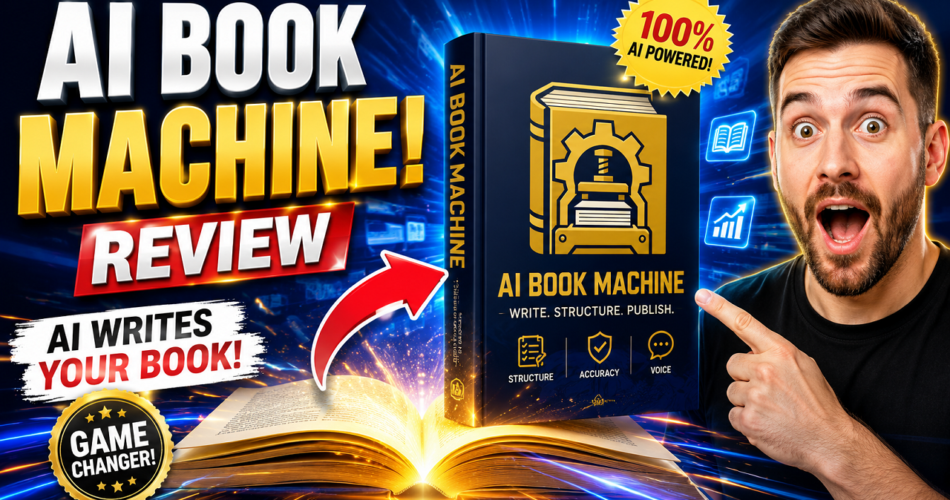
AI Book Machine Review: Can It Really Create a Complete Business Book for You?
Introduction: What Is AI Book Machine?
When I first heard about AI Book Machine, the biggest thing that caught my attention was the way the product positions itself. This isn’t presented as another AI writing assistant that gives you a few ideas, outlines, or paragraphs and then leaves you to assemble everything yourself. The concept is much more ambitious: AI Book Machine doesn’t simply help you write a book—it is designed to write the book with you moving through a structured production process.
That distinction matters.
Most people who want to create a business book, lead magnet, guide, or information product aren’t necessarily struggling because they can’t type words into a document. The bigger challenge is turning what they know into something organized, useful, consistent, and professional enough for another person to actually want to read.
AI Book Machine is designed to take a user’s existing knowledge, expertise, ideas, or business information and move it through a series of specialized “stations.” These stations are intended to check important elements such as structure, accuracy, and voice as individual chapters are created.
In other words, this isn’t being positioned as a chatbot wrapper or a collection of prompts. It is intended to function more like a book-production engine.
In this AI Book Machine review, I’m going to look closely at how that concept could benefit entrepreneurs, marketers, consultants, coaches, agencies, creators, and other experts who want to transform their knowledge into a finished written asset without facing the traditional blank-page problem.
👤Vendor: Andrew Darius
🎁Product: AI Book Machine
🗓️Launch Date: 2026-Aug-14
🏷️Front-End Price: $47
🎟️ Coupon: Use “bonanza20” for 20% off for the whole funnel!
⭐Recommend: Highly recommend
🏆Skill: All Levels
🏅Guarantee: 30-Day Money Back Guarantee
🛎️Support: Еffесtіvе Rеѕроnѕе
🔥 Visit the Official Website
AI Book Machine Product Summary
At its core, AI Book Machine is designed to turn what you already know into a professionally structured written product.
Rather than asking an AI chatbot to “write me a book about marketing” and hoping for the best, the system takes a more organized approach. The goal is to move your knowledge through a workflow that develops the structure, chapters, voice, and overall direction of the finished project.
What Can AI Book Machine Create?
The platform appears especially suited to creating:
- Business books
- Lead magnets
- Educational guides
- Authority-building books
- Information products
- Client resources
- Expertise-based content
- Marketing assets
- Long-form educational material
I think this distinction is important because not every user needs to become a traditionally published author.
A consultant, for example, might want a short book that explains a proprietary methodology. A marketing agency might need a lead magnet. A coach could turn an existing framework into an information product.
AI Book Machine is designed around those practical business applications.
AI Book Machine Design and Quality
One thing I like about the underlying concept is that the design seems to focus more on workflow than prompting.
That’s an important difference.
With a normal chatbot, I might enter a prompt, receive a response, enter another prompt, correct something, rewrite another section, and repeat the process dozens of times. The quality of the finished book then depends heavily on my ability to manage all of those disconnected interactions.
AI Book Machine attempts to solve this with its station-based approach.
A Structured Production Environment
Instead of treating book creation as one giant generation request, the platform breaks the process into stages.
That makes sense to me because professional books aren’t really created as one enormous block of text either.
They have:
- A central purpose
- A defined reader
- Logical organization
- Chapters with specific jobs
- Consistent terminology
- A recognizable voice
- Supporting explanations
- Transitions between ideas
- A meaningful conclusion
The quality of an AI-generated book therefore depends on much more than whether the individual sentences sound good.
The system’s focus on structure, accuracy, and voice suggests that it is trying to address those broader quality issues.
AI Book Machine Key Features and Functionality
1. Complete Book Creation
The biggest selling point is straightforward: AI Book Machine is intended to create the book rather than merely assist with writing it.
That’s a significant difference for someone who has valuable expertise but doesn’t consider themselves a writer.
You may know exactly how to generate leads, manage employees, improve productivity, build websites, coach clients, or solve a specialized industry problem. Turning that knowledge into 100+ pages of organized material is another skill entirely.
AI Book Machine attempts to bridge that gap.
Why This Feature Matters
A traditional AI assistant can certainly generate text. The problem is maintaining coherence across a large project.
Chapter seven needs to make sense in relation to chapter two. Terminology shouldn’t randomly change halfway through the book. Concepts shouldn’t be unnecessarily repeated. The tone should feel consistent.
By treating the book as a complete project instead of a collection of isolated prompts, AI Book Machine potentially makes long-form creation considerably easier.
2. Station-Based Book Production
The “stations” are one of the most interesting aspects of AI Book Machine.
Rather than relying on one generic AI interaction to handle everything, different parts of the workflow are designed to evaluate or develop specific elements of the book.
I see this as something closer to an assembly line for knowledge.
You provide the raw material—your knowledge, ideas, experience, frameworks, and perspective—and the system helps move that material toward a structured finished product.
Why Stations Could Produce Better Results
The advantage is specialization.
Trying to accomplish planning, writing, editing, fact-checking, tone management, and structural analysis simultaneously is difficult even for human writers.
Separating those responsibilities can create a more disciplined workflow.
That’s especially useful for AI-generated long-form content, where consistency becomes increasingly difficult as the document gets longer.
3. Structure Checking
Good information isn’t automatically a good book.
I’ve seen plenty of content that contains excellent advice but feels difficult to follow because everything is presented in the wrong order.
AI Book Machine’s emphasis on structure is therefore one of its more valuable ideas.
Moving the Reader From Point A to Point B
A strong business book normally begins with the reader’s current situation and gradually moves them toward a new understanding or desired outcome.
That requires progression.
The reader should feel like each chapter naturally prepares them for the next one.
If AI Book Machine successfully maintains that progression, it can solve one of the biggest weaknesses associated with casually generating long-form content through standard AI tools.
4. Accuracy Checks
Accuracy becomes increasingly important when you’re publishing under your own name or brand.
I wouldn’t want to put my reputation behind a book containing obviously incorrect information simply because an AI model generated it.
AI Book Machine specifically emphasizes checking accuracy throughout the chapter-production process.
Why Human Review Still Matters
I would still recommend manually reviewing important factual claims.
No AI-generated content should automatically be assumed to be perfect, particularly when dealing with statistics, laws, financial information, health claims, dates, citations, or rapidly changing industries.
The built-in accuracy focus can add another layer of quality control, but I wouldn’t treat it as a replacement for responsible final verification.
5. Voice Consistency
One problem I’ve noticed with long-form AI content is that the voice can drift.
One chapter might sound conversational. Another suddenly sounds like a university textbook. Another becomes overly promotional.
That makes a book feel assembled rather than authored.
AI Book Machine attempts to check voice throughout the chapters.
Why Voice Matters
Readers form a relationship with the author through tone.
If I’m creating a book to establish authority in my industry, I want readers to feel like they’re hearing from the same person throughout the entire experience.
Maintaining a consistent voice can therefore make the finished book feel more credible, polished, and intentional.
6. Business Book Creation
AI Book Machine appears particularly well suited to business-focused publishing.
That’s an important distinction because business books generally have a specific purpose beyond simply entertaining readers.
A business book can:
- Establish authority
- Explain a proprietary method
- Educate prospects
- Support consulting services
- Generate leads
- Pre-sell potential customers
- Strengthen a personal brand
That means the book itself can become a marketing asset.
For entrepreneurs and professionals, I think that’s where AI Book Machine becomes particularly interesting.
7. Lead Magnet Creation
Not everyone needs a 200-page book.
Sometimes a focused 20- or 30-page guide can be more valuable because it solves one immediate problem for a prospect.
AI Book Machine can also be used to produce lead magnets.
I could see this being particularly useful for agencies, consultants, affiliate marketers, coaches, SaaS companies, and service businesses.
Instead of offering another generic checklist, a business could potentially offer a professionally structured mini-book that demonstrates expertise while preparing prospects for the next step.
8. Information Product Creation
The same underlying technology can potentially help create paid educational information products.
Someone with specialized knowledge might know exactly what customers need to learn but struggle to organize that knowledge into a sellable product.
AI Book Machine can potentially shorten that production process considerably.
The key advantage isn’t simply generating more words. It’s packaging knowledge.
And commercially, packaging can be extremely valuable.
AI Book Machine vs. Similar AI Writing Tools
Standard AI Chatbots
General AI chatbots are incredibly flexible.
They can brainstorm titles, create outlines, rewrite paragraphs, summarize research, and generate chapters.
Their weakness is that the user generally has to manage the overall project.
AI Book Machine’s advantage is specialization.
Instead of providing an empty chat box and expecting me to engineer the entire workflow myself, it is designed specifically around moving knowledge toward a finished book.
Prompt Packs
Prompt packs can provide useful starting points, but they’re fundamentally instructions.
I still have to run the prompts, organize the outputs, maintain consistency, correct problems, and assemble everything.
AI Book Machine specifically distinguishes itself from this model.
It’s intended to be an engine rather than a folder full of clever prompts.
Traditional AI Book Generators
Many AI book generators emphasize speed: enter a topic and generate thousands of words.
That sounds impressive until the resulting manuscript starts repeating itself, drifting off-topic, or presenting shallow information.
AI Book Machine’s structural and quality-control approach potentially offers a stronger alternative because the emphasis isn’t simply on word count.
Pros and Cons of AI Book Machine
Pros
Complete production approach: It aims to create an entire book rather than simply helping with isolated writing tasks.
Structured workflow: The station-based system can make a complicated project feel more manageable.
Voice checking: Maintaining consistent tone can improve the professionalism of long-form content.
Structure checking: This helps ensure chapters contribute to a logical reader journey.
Accuracy focus: An additional layer of checking can potentially reduce low-quality AI output.
Multiple use cases: The technology can be applied to books, lead magnets, and information products.
Business-friendly: It has clear applications for consultants, coaches, marketers, entrepreneurs, agencies, and experts.
Cons
Human review is still important: I wouldn’t publish an AI-generated manuscript without personally checking it.
Input quality matters: AI cannot magically extract expertise that hasn’t been adequately communicated to it.
Editing may still be necessary: Generated chapters may require personal stories, examples, evidence, or refinements.
Not necessarily ideal for every genre: The business-oriented workflow may be more valuable for expertise-based publishing than highly artistic literary writing.
Why AI Book Machine May Be Better Than Other AI Book Tools
The biggest advantage, in my view, comes down to one word: process.
Generating words isn’t particularly difficult anymore.
Generating a coherent long-form product that sounds consistent, teaches something useful, follows a logical progression, and supports a business objective is considerably harder.
AI Book Machine is attempting to solve the second problem.
Instead of giving users another blank chatbot window, it provides a purpose-built production workflow.
That’s potentially far more useful for someone whose objective isn’t to “play with AI” but to actually finish and publish something.
What Customers Say About AI Book Machine
Because individual online testimonials can change over time, I wouldn’t present invented quotations as genuine customer reviews. However, these are the seven areas I would specifically look for when evaluating verified customer feedback about AI Book Machine.
1. Customers Value the Time-Saving Potential
For many prospective users, the obvious attraction is reducing the amount of time required to transform knowledge into long-form content.
Instead of manually outlining, drafting, reorganizing, and rewriting every chapter, much of the production workflow can potentially be accelerated.
2. Customers Want More Than Generic AI Text
One of the biggest concerns surrounding AI books is generic output.
The structured approach should appeal to users who have tried ordinary AI writing tools but found that assembling dozens of generated sections into one coherent manuscript required too much manual effort.
3. Business Owners Can Turn Expertise Into Assets
Entrepreneurs may see particular value in converting knowledge they already possess into something tangible.
Instead of leaving expertise inside presentations, videos, notes, or their own heads, they can potentially transform it into an authority-building asset.
4. Lead Generation Is a Strong Use Case
Marketers don’t necessarily need to sell the finished book.
Giving it away can be valuable if it attracts qualified prospects.
A well-produced educational book can create more perceived value than a basic PDF checklist.
5. Consistency Can Be a Major Benefit
Users creating longer content are likely to appreciate tools that help maintain a consistent structure and voice.
This becomes increasingly important as projects grow.
6. Editing Remains Part of the Process
I’d expect serious users to recognize that automation doesn’t eliminate the need for final review.
The strongest results will likely come from people who treat the generated book as a professionally assisted manuscript rather than something they blindly publish.
7. The Finished Asset Is More Important Than the AI
Ultimately, customers aren’t buying words.
They’re trying to create something useful—a book, lead magnet, authority asset, or information product.
That’s the standard I’d use when evaluating customer experiences.
Tips and Tricks for Getting Better Results
Give AI Book Machine Strong Source Material
Don’t provide vague ideas if you already have detailed expertise.
Feed the system frameworks, notes, examples, terminology, processes, lessons learned, and customer insights whenever possible.
Define Your Reader Clearly
A book written for “business owners” will probably be less focused than one written for “local service-business owners struggling to generate consistent leads.”
Specific audiences generally produce more useful content.
Establish the Transformation
Ask yourself:
What should the reader understand or be able to do after finishing this book?
That answer should guide the entire project.
Add Personal Experiences
AI can organize information, but your own experiences can make the finished book uniquely yours.
Add stories, mistakes, lessons, case studies, and personal observations.
Fact-Check Important Claims
Verify statistics, quotations, dates, legal claims, financial information, and other high-stakes factual material before publishing.
Read the Final Book From Beginning to End
Don’t review chapters exclusively in isolation.
Reading the complete manuscript helps uncover repetition, weak transitions, inconsistencies, and missing information.
Create Multiple Assets From One Knowledge Base
Think beyond the book itself.
A strong manuscript can potentially become material for emails, blog posts, presentations, lead magnets, videos, courses, and social media co
Why AI Book Machine Will Work for You
You Already Have Knowledge but Need Structure
This is where I think the product makes the most sense.
If you don’t know anything about your chosen subject, no software can magically turn you into a credible expert.
But if you already understand your subject and simply struggle to organize everything, AI Book Machine could remove a major bottleneck.
Your knowledge becomes the raw material.
The engine helps transform it into the finished asset.
You Want to Build Authority
A well-written business book can immediately communicate expertise.
Instead of repeatedly explaining your entire methodology to prospects, you can point them toward something structured that demonstrates how you think.
That can be valuable for consultants, speakers, coaches, agency owners, and other professionals whose expertise is part of what customers are buying.
Who Is AI Book Machine For?
I see AI Book Machine being particularly useful for:
Entrepreneurs who want to establish authority in their market.
Coaches who want to transform frameworks into books or educational products.
Consultants who want to document proprietary methodologies.
Marketing agencies that need lead-generation assets.
Affiliate marketers who create educational content.
Course creators who want to convert expertise into structured written material.
Speakers who want to expand presentations into books.
Subject-matter experts who know their topic but aren’t comfortable writing long-form content.
It may be less attractive to someone who genuinely loves writing every sentence manually or to authors whose primary objective is highly artistic literary fiction.
AI Book Machine Product Specifications
Product Type
AI-powered book and information-product creation engine.
Primary Purpose
Transform existing knowledge and expertise into professionally structured long-form content.
Primary Content Types
Business books, lead magnets, educational resources, and information products.
Core Workflow
A station-based production process rather than a conventional standalone chatbot interaction.
Quality-Control Focus
Structure, accuracy, and voice throughout chapter development.
Ideal Users
Entrepreneurs, marketers, coaches, consultants, creators, agencies, and subject-matter experts.
Primary Benefit
Reducing the complexity and manual workload involved in transforming knowledge into a complete, organized written asset.
zed written asset.
Prices And Upsells
Front End: AI Book Machine $27
Their brain-dump becomes a finished, professionally-structured guide — chapters written one at a time, each put through three named quality gates — the finished manuscript at the end.
AI Book Machine PRO — All-Access: $97
Unlocks every fiction genre and every non-fiction category instead of the single one they picked at checkout.
Publish-Ready Pack: $47
A designed KDP ebook cover, the KDP-ready files, and the metadata and category picks — the whole gap between a finished manuscript and a listing that is actually live.
Reader Engine Toolkit: $67
Turns the book they just finished into a reader magnet, a welcome email sequence and an end-matter page with a QR code — the list-building asset the book was always supposed to produce.
Custom-Voice Audiobook: $67
They design a narrator voice and preview it, then the whole book is narrated in that voice: a third format out of a manuscript they have already paid to write.
The Agency: $297
A commercial licence to run the engine on books for paying clients, not just their own — the permission that turns the tool into a service they can offer. One-time, no monthly fee.
Overall Value
I think AI Book Machine’s value depends largely on what you intend to do with the finished content.
If you’re generating a random ebook that nobody will read, saving time isn’t especially valuable.
But imagine that one book becomes your primary lead magnet.
That book generates prospects.
Those prospects become consulting clients.
Parts of the manuscript become blog articles, email campaigns, videos, presentations, and course lessons.
Suddenly, the original asset has considerably more business value.
That’s why I wouldn’t evaluate AI Book Machine purely as an AI writer.
I’d evaluate it as an intellectual-property production tool.
The more valuable your knowledge is, and the more ways you can deploy the finished content, the stronger the potential return becomes.
AI Book Machine Review: Final Recommendation
After looking at what AI Book Machine is designed to accomplish, I think its strongest idea is also its simplest one:
It doesn’t just help you write a book. It’s designed to move you through the process of creating the book.
That’s an important distinction.
General AI tools are already excellent at generating individual pieces of text. The harder problem is taking someone’s real-world knowledge and turning it into a coherent, structured, consistent, professionally presented long-form asset.
The station-based approach—particularly the emphasis on structure, accuracy, and voice—is what makes AI Book Machine stand out conceptually from basic prompt packs and generic chatbot workflows.
There are still drawbacks.
I wouldn’t assume that AI eliminates editing, fact-checking, or human judgment. I would personally review every important chapter before putting my name on the finished product. I’d also add original stories, examples, opinions, and experiences wherever possible.
But those limitations don’t undermine the central benefit.
For entrepreneurs, coaches, consultants, marketers, agencies, creators, and experts who know their subject but struggle to transform that knowledge into a complete book, AI Book Machine could offer a compelling shortcut between expertise and publication.
Final Verdict
If your biggest obstacle isn’t a lack of knowledge but the time, structure, organization, and writing required to package that knowledge professionally, AI Book Machine is worth considering.
I especially like the idea for users who aren’t simply trying to “write an ebook,” but want to create a business asset that can educate prospects, establish authority, generate leads, support an offer, or become the foundation of a larger information product.
The technology shouldn’t replace your expertise.
Used correctly, its job is much more useful than that: helping package your expertise into something other people can actually consume.
content.
Frequently Asked Questions
Does AI Book Machine Actually Write the Book?
Yes—that is the central proposition.
Rather than merely assisting with brainstorming or providing prompts, AI Book Machine is designed to take the user’s knowledge through a structured process toward a complete business book, lead magnet, or information product.
Is AI Book Machine Just a ChatGPT Wrapper?
Based on the supplied product description, no.
The product specifically positions itself as something other than a chatbot wrapper or prompt pack. Its distinguishing concept is an engine containing stations that evaluate aspects such as structure, accuracy, and voice throughout chapter production.
Do I Need to Be a Professional Writer?
The product is particularly interesting precisely because many potential users aren’t professional writers.
The value proposition is turning expertise into structured written material without requiring the user to personally draft every sentence.
However, knowing your subject well will still improve the finished result.
Can I Use AI Book Machine for Lead Magnets?
Yes.
Lead magnet production appears to be one of the platform’s core applications. This could be particularly useful for consultants, coaches, agencies, marketers, and businesses that use educational content to generate leads.
Can AI Book Machine Create Information Products?
Yes.
Its structured approach can potentially be applied to information products in addition to conventional books.
This could help experts package existing knowledge into something that can be distributed or sold.
Should I Publish the Generated Book Without Editing It?
I wouldn’t.
Even with structure and accuracy checks, I recommend personally reviewing anything published under your name.
Add your experiences, confirm important claims, eliminate unnecessary repetition, and make sure the finished material genuinely represents your expertise.
Who Benefits Most From AI Book Machine?
I think the strongest potential users are entrepreneurs, consultants, coaches, marketers, agencies, educators, creators, and subject-matter experts.
Basically, if you have valuable knowledge but don’t want to spend months turning it into a professional book, this type of system could be particularly appealing.